


About
This project aims to examine the experiences of care leavers who became parents (of cohort members) and the intergenerational impact on their children’s outcomes, from childhood into early adulthood. The research uses information from the 1970 British Cohort Study and the Millennium Cohort Study.
Principal Investigator
Sam ParsonsProject dates
March 2021 – January 2027Funder
Nuffield Foundation – visit the project page on the Nuffield Foundation website.
On this page:
This study examines the experiences of care leavers who became parents and the intergenerational impact on their children’s outcomes. The care leavers in this study are parents of cohort members.
Using information from the 1970 British Cohort Study (BCS70) and the Millennium Cohort Study (MCS), the aims of the study are to examine:
The project team examined the adjustment of these children across a range of domains, including cognitive and behavioural development, experiences at school and physical and emotional wellbeing. It evidenced a wide range of socioeconomic and wellbeing markers for care-experienced parents, including their access to health care.
Prior research has revealed a link between care experience and poorer outcomes later in life. The 2013 Care Leaver Strategy, published by the UK Government, identified key areas where care leavers needed more robust support: education, employment, finance, health, housing, justice system and ongoing support.
The research identifies opportunities to support care-experienced parents and will inform policies to support future care leavers to become independent, and to improve their life chances and those of their children.
This poster introduces the care leavers project and also shows how care leavers and their children experienced the Covid-19 pandemic.

NEWS
Teenagers with care experience at greater risk of serious mental health difficulties
Young people with out of home care (OHC) experience face multiple health, social and socioeconomic disadvantages in their late teens and early twenties, according to new UCL research.
14 January 2026
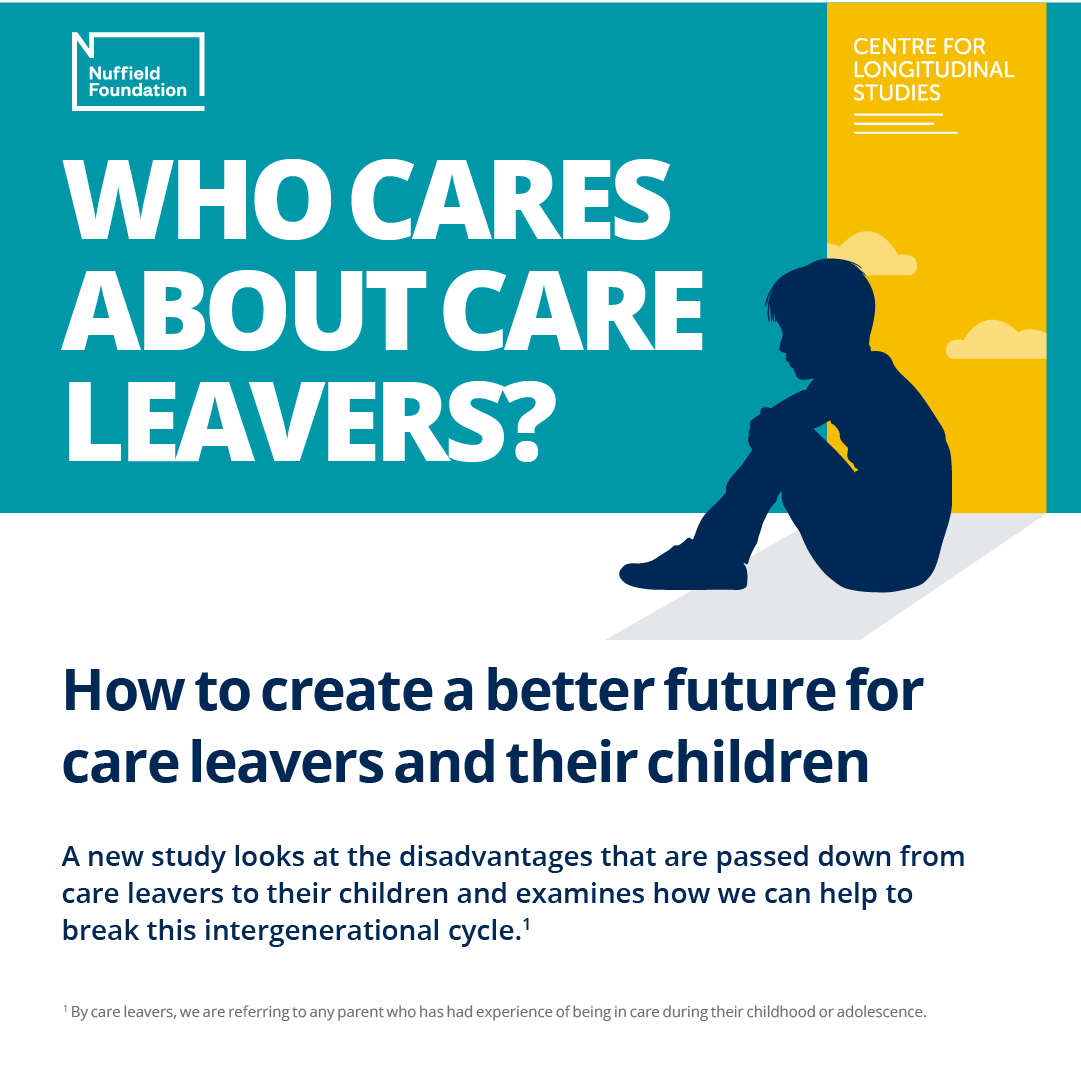
INFOGRAPHIC
Who cares about care leavers?
7 February 2024

News
Children of care leavers risk inheriting parents’ emotional scars
7 February 2024
RESEARCH SUMMARY
Long-term outcomes for care leavers who became parents and experiences of their children
7 February 2024
Briefing papers
Care leavers and their children: Evidence on how care experience affects the next generation – policy briefing
This policy briefing examines findings from the first UK study to look at care leavers as mothers, following their development and that of their children from early childhood to adolescence and into adulthood, using two British cohort studies. It shows how the long-term effects of care experience can be eased.
Briefing papers
Resources available to mothers who experienced out-of-home care in childhood: Evidence from the UK Millennium Cohort Study
What are the socioeconomic and psychosocial resources available to female care-leavers who became mothers? It is well documented that the experience of out-of-home care can lead to more problematic post-16 transitions and poorer adult outcomes. This new research examines the experiences of care-leavers who become mothers.
Briefing papers
Mental health of at-risk teenagers – Evidence from children of care leavers and those from socially disadvantaged families in the Millennium Cohort Study
Transgenerational transmission of trauma. Heterogeneity in the experiences of mothers who experienced out-of-home care (OHC) and adjustment of their children
Children and Youth Services Review
Maternal out-of-home care experience and offspring symptom development across domains: a latent profile analysis of a UK longitudinal population sample
BMJ Open
Digging deeper: further examination of the association between Out of Home Care experience and poor outcomes, focusing on mental health and wellbeing
CLS research report
The OHC penalty in the UK: maternal experience and child development
Longitudinal and Lifecourse Studies
Long-term outcomes for care leavers who became parents and experiences of their children – Evidence on the intergenerational transmission of disadvantage in two British cohort studies
CLS research report
Long-term outcomes for care leavers who became parents and experiences of their children – Evidence on the intergenerational transmission of disadvantage in two British cohort studies
CLS research report appendix
Intergenerational transmission of educational disadvantage: Education progression of children of care leavers compared to a general population sample
BERA Journal
The relationship between maternal care experience and early child development: Evidence from the UK
CLS Working Paper
Evidence from the UK Millennium Cohort Study. Teenage children of mothers who experienced out-of-home care: How are they doing?
Quantative Social Science working paper
Intergenerational transmission of educational disadvantage: Educational progression of children of care leavers compared to other children in a general population sample
CLS working paper
Does the trauma associated with out-of-home care transmit across generations? Evidence from the 1970 British Cohort Study during a major health pandemic
BMJ Open
Descriptive profile of mothers by their experience of out-of-home care in childhood: evidence from the UK Millennium Cohort Study
Econ Papers
Sam Parsons
Principal Research Fellow

Emla Fitzsimons
Professor of Economics and CLS Director

Ingrid Schoon
Professor of Human Development and Social Policy at the UCL Social Research Institute (SRI)
The researchers used data from the following cohort studies in this project:

1970 British Cohort Study
The 1970 British Cohort Study (BCS70) is following the lives of around 17,000 people born in England, Scotland and Wales in a single week of 1970.

Millennium Cohort Study
The Millennium Cohort Study (MCS) is following the lives of around 19,000 young people born across England, Scotland, Wales and Northern Ireland in 2000-02.
Centre for Longitudinal Studies
UCL Social Research Institute
20 Bedford Way
London WC1H 0AL
Email: clsdata@ucl.ac.uk